
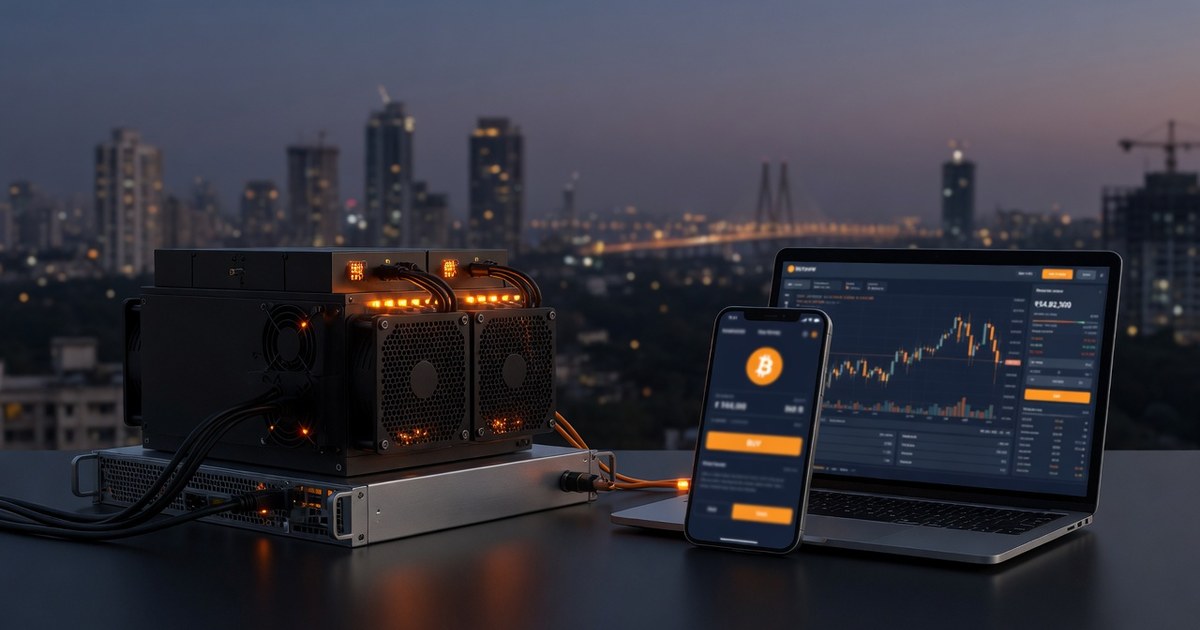
Many people discover Bitcoin and immediately ask: Should I mine it? In India that question is really about electricity, capital, noise, heat, and opportunity cost — not only hashrate marketing slides.
This article compares running ASIC miners with buying Bitcoin on the open market and holding it. Use it with the free Bitcoin mining calculator on P2P Miner Store to turn assumptions into INR and BTC estimates.
What mining actually is
Mining is not “printing free Bitcoin.” Miners sell computation to the network: they compete to find blocks, earn the block subsidy (currently 3.125 BTC) plus fees, and pay real-world costs — hardware, power, cooling, hosting, downtime, and pool fees.
Your share of rewards roughly tracks:
your hashrate ÷ global network hashrate
As the network grows, the same machine earns fewer BTC over time unless you keep reinvesting in newer hardware.
What buying Bitcoin is
Buying Bitcoin is purchasing BTC that already exists (or was newly issued to someone else). You pay a market price, often plus exchange fees and taxes depending on your route. You avoid:
- ASIC purchase and import complexity
- 24/7 power bills
- Heat, noise, and fire risk at home
- Hardware obsolescence every hardware cycle
Your main risks become custody, scams, and your own holding discipline — not cooling towers.
Side-by-side comparison (India lens)
| Factor | Mining | Buying & holding |
|---|---|---|
| Upfront capital | High (ASIC + PSU + infra) | Flexible (start small with DCA) |
| Ongoing cost | Electricity every hour | Negligible if self-custodied |
| Skill required | Ops, power, firmware, hosting | Security and key management |
| BTC accumulation | Variable; depends on difficulty & power price | Known sats for known rupees |
| Residential fit in India | Poor for most homes | Practical for most people |
| Opportunity cost | Capital locked in depreciating machines | Capital in a liquid asset |
When mining can make sense
Mining is more defensible when several of these are true:
- Cheap, reliable power (often industrial / commercial tariff, not peak residential slabs)
- Proper facility (noise, heat, electrical load handled professionally)
- You understand difficulty increases and plan for hardware refresh
- You treat mining as a business with accounts, not a hobby for “free coins”
- You already have a plan for custody of mined coins
When buying is usually smarter
For most individuals and many family offices in India:
- You want Bitcoin exposure without operational complexity
- Your ₹/kWh makes the calculator show thin or negative profit
- You value time more than tinkering with ASICs
- Your goal is long-term sovereignty and savings, not a hashrate business
Buying Bitcoin is not “lazy mining.” It is often the rational way to obtain BTC when your cost of production is higher than the market price.
How to decide with numbers
- Open the Bitcoin mining calculator on P2P Miner Store.
- Pick a miner model (or enter custom TH/s and watts).
- Enter your real electricity rate in ₹/kWh.
- Note daily / monthly / annual BTC earned and INR profit after power.
- Compare that profit path with simply buying the same rupees’ worth of BTC over the same period — and remember the calculator does not include machine purchase cost.
If profit after electricity is weak before counting the ASIC invoice, mining is rarely a path to “cheaper Bitcoin.”
Related reading in this series
- Bitcoin mining consultancy in India
- Bitcoin mining electricity cost & break-even in India
- Bitcoin mining for companies: operations vs treasury
- Self-custody for mined Bitcoin
- Bitcoin for beginners
Next step
If you are weighing a mining purchase against a treasury or personal stacking plan, book a session. Strategy first — hardware second.
Educational content only. Not financial, tax, or legal advice. Mining profitability changes with price, difficulty, and power tariffs.